Together
By Design
Principle 2.6
Beacon Invitations
Engage people with emotions, not bland logistics.
While most community outreach focuses on conveying information - when, where, what to expect - Beacon Invitations go deeper. They create an immediate, tangible experience that serves as both invitation and preview of what the community offers. Rather than simply announcing an event, they invite recipients into a "call to adventure" that feels personally meaningful and emotionally engaging.
Beacon Invitations differ from standard marketing communications in several ways:
-
They address needs or wishes that recipients already have, rather than trying to create demand.
-
They offer an immediate sense of discovery and possibility - something serendipitous or out of the ordinary that invites exploration.
-
They stand out, sometimes because of the craft and generosity that went into making them (such as hand-written invitations), sometimes because they invert expectations (such as an interactive object unexpectedly encountered in the street), sometimes because they are so personally relevant.
-
They signal the possibility of genuine change.
Beacon Invitations work through a series of stages.
-
Addressing a real need in the recipient's life, often one that mirrors the community founder's own initial purpose for creating the group.
-
They create a moment of discovery that feels special rather than routine - perhaps through unusual materials, unexpected delivery methods or
intriguing presentation. -
They demonstrate the ‘community in microcosm’ through the invitation itself, showing rather than telling what kind of experience awaits.
-
Finally, they provide a clear pathway to engage while signalling what mindset or approach recipients should bring to participation.
The stages can happen all at once (as in the single letter sent by Gather), or be spaced out over time in several engagements.
Because Beacon Invitations tap into personal needs and emotions they require careful attention to intentions and expectations. Recipients should always have genuine choice about whether to participate, without manipulation or coercion. The line between creating healthy intrigue and engaging in deceptive practices requires constant vigilance. They should be made with consideration to accessibility.
These invitations work precisely because they're tightly targeted rather than
broadly appealing. They may be rare, mysterious or hard to find, emphasising rich, tangible experiences over thin or digitalised communications. By appealing to the senses and creating moments where recipients feel fully present, they generate the kind of specialness and care that makes people feel genuinely welcomed rather than merely recruited.
Examples
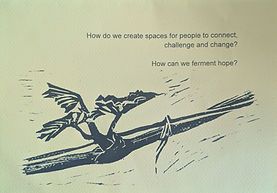
The Gather invitation creates an emotional experience - feelings of excitement and adventure, a sense of being welcomed into a new world full of possibilities. The envelope to Gather’s first event is crafted from an old map and contains a handmade linoprint.

Slow Dance Soiree used simple chalk drawings on the steps to echo the design of earlier communications. It helped out-of-town attendees to easily find the building, and was in keeping with the down-to-earth, friendly feel of the event.

Stuffed Animal Contest flyers invited people to show up in a park to tell stories about their favorite stuffed animals. As well as logistical details, it gave a sense of the whimsical event, what to bring and the playful mindset that attendees should show up with.

The TactIcons study showed that 3D-printed tactile icons, designed to be recognisable by touch, help blind and low-vision people interpret maps more intuitively than traditional textures or braille keys. For inclusive invitations, this idea could be adapted by pairing a small tactile token or map preview with a digital invite, giving recipients both a sensory cue and accessible event information. Such tokens can act as memorable, low-cost orientation aids, making invites more engaging and signalling that disabled guests’ needs have been considered from the start.
